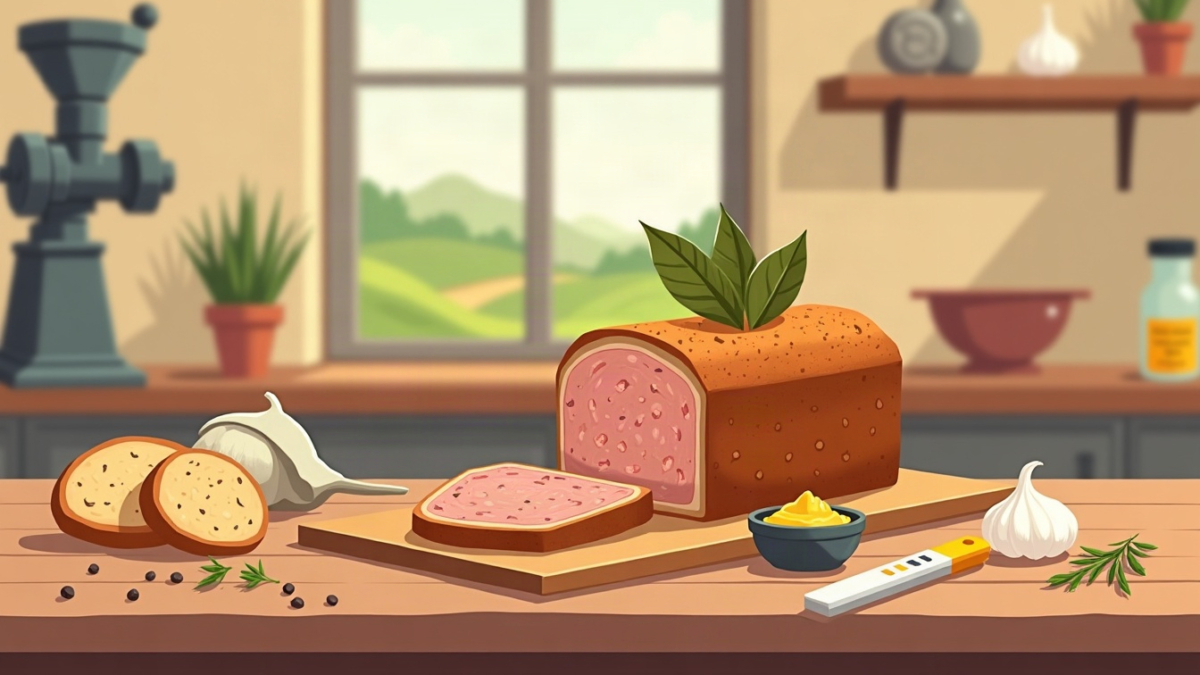

A country pâté, or pâté de campagne, is pork, pork fat and pork liver, coarsely ground, seasoned and baked slowly in the oven. The recipe fits in a few lines, but three numbers decide everything: how much fat goes in, how much salt to the gram, and the temperature at the center of the terrine. This guide gives you all three with their sources, then tells you honestly how long your pâté keeps.
What you’ll learn
- What a pâté de campagne really is, according to the rules French charcutiers follow.
- How long to bake it depending on its weight, and why your thermometer has the last word.
- A step-by-step recipe for 2.2 lb (1 kg) of meat, with the salt measured to the gram.
- The most common failures, and how to avoid them.
- How long a homemade pâté keeps, and what you need to know before you put it in jars.
Sommaire
I owe you some honesty before we start: I haven’t made a country pâté myself yet. Rather than copy one more recipe, I went looking for the documents French professionals actually follow. The first is the French charcuterie code, the Code des usages de la charcuterie, which sets what a charcutier is allowed to call a “pâté de campagne”. The others are the official specifications of the Breton country pâté, which has protected geographical status, and of the French Label Rouge quality mark. I added the advice of Gilles Vérot, who holds the title of Meilleur Ouvrier de France in charcuterie, and of Michael Ruhlman, the American reference on the subject.
This guide adapts those rules to a home kitchen. When I make my first pâté, I’ll come back and update this article with my own numbers.
1. What a country pâté really is
1.1 The charcutiers’ definition
The French charcuterie code defines it as a preparation “obtained by grinding, mixing and cooking pork meat, offal and fat”. So it is an all-pork product, and the liver is not an optional extra: it is what sets a country pâté apart from a simple baked meatloaf.
For the standard country pâté, the kind sold in French supermarkets, the code requires at least 10% liver and a coarse grind, through a 4 mm plate. Premium pâtés go much further. The Label Rouge specification requires at least 25% pork jowl and 22% liver. The Breton country pâté calls for at least 25% jowl and 20% liver, along with fresh onions and a little cooked pork rind.
1.2 Why jowl and liver
Pork jowl is the cheek and neck of the pig, where fat and lean meat alternate in layers. It is what gives French pâté its melting texture. The Label Rouge specification explains that the fat makes the pâté spreadable “without giving it overly pronounced fatty flavors”.
The liver plays two roles. It brings the characteristic taste of a country pâté, and its proteins bind the mixture. The same specification spells it out: enough liver gives “a texture without phase separation”. In other words, a pâté without enough liver is likely to release its fat in the oven.
1.3 Pâté or terrine?
In everyday cooking, both words mean the same thing, and English-language cookbooks use “country pâté” and “country terrine” interchangeably. Originally, a pâté was baked inside a pastry crust, and a terrine in an earthenware dish. Gilles Vérot draws another line: for him, a terrine has a coarser grind with visible pieces, while a pâté is often finer.
2. Cooking time and temperature: the short answer
2.1 Internal temperature decides
Your pâté is done when the center of the terrine reaches 160 °F (71 °C). That is the minimum the USDA sets for any ground pork. French professionals aim slightly higher: the Label Rouge and Gilles Vérot both use 72 °C (162 °F), and the Breton specification goes up to 75 °C (167 °F).
You will find recipes that pull the pâté out between 145 °F and 158 °F (63 to 70 °C), including in respected English-language books. They are after a moister pâté, but they stay below the USDA minimum for ground pork. Vérot sums it up well: it is better to cook it a little too much, even if your pâté ends up a bit drier, than not enough.
So you need a probe thermometer. Push it right into the center of the terrine, halfway down and halfway across: that is the last spot to heat up.
2.2 How long in the oven, by weight
For a 2.2 lb (1 kg) terrine, Gilles Vérot allows about 1 hour 30 minutes at 320 °F (160 °C). The other serious recipes I read range from 1 hour to 2½ hours for the same weight, with ovens set between 300 °F and 355 °F (150 to 180 °C). That is a huge gap, and there is a reason for it: the time depends less on weight than on the shape of the mold. A narrow, shallow terrine cooks much faster than a tall, round one of the same weight.
No serious source gives a minutes-per-pound rule. Here instead is when to start checking, for an oven at 320 °F (160 °C) with a water bath:
| What you’re baking | Start checking after | Rough total time |
|---|---|---|
| Jars or a small 1 lb (500 g) terrine | 45 minutes | 1 hour to 1 hour 15 |
| 2.2 lb (1 kg) terrine | 1 hour 10 | about 1 hour 30 |
| 3.3 lb (1.5 kg) terrine | 1 hour 30 | 1 hour 45 to 2 hours |
| 4.4 lb (2 kg) terrine | 1 hour 45 | 2 hours or more |
These are cues for when to check, not cooking times. Your pâté is done when the probe reads 160 °F (71 °C), and not before.
2.3 How much salt
Use 18 g of fine salt per kilo of meat, liver included, which is 1.8%. Recipes that weigh their salt range from 15 g per kilo in French recipes to about 23 g in Ruhlman’s. The Breton specification caps salt at 2%, or 20 g per kilo. At 18 g, you sit in the middle, under that cap.
Weigh your salt rather than measuring it with a spoon. A spoonful of kosher salt and a spoonful of table salt don’t weigh the same at all, and the difference shows in a cold pâté.
3. Step-by-step recipe for 2.2 lb (1 kg) of meat
3.1 Ingredients
The meat proportions follow the Label Rouge minimums: at least a quarter jowl, and a little more than a fifth liver.
The meat (2.2 lb / 1 kg in total)
- 14 oz (400 g) skinless pork jowl. Fresh jowl is hard to find outside France: ask a butcher who breaks down whole pigs, and order it ahead. Otherwise use fresh, unsmoked pork belly. Don’t use guanciale, which is already salted and cured.
- 12 oz (350 g) pork shoulder (Boston butt), with its fat.
- 9 oz (250 g) very fresh pork liver.
The seasoning
- 18 g fine salt.
- 3 g freshly ground black pepper.
- 2 g quatre épices, the French four-spice blend of pepper, cloves, nutmeg and ginger. Allspice is not the same thing: it is a single spice.
- 1 shallot, very finely chopped.
- 1 garlic clove, crushed.
- 2 tablespoons (30 ml) cognac or brandy, or dry white wine.
The binder
- 1 large egg.
- 3½ tablespoons (50 g) heavy cream, or double cream in the UK.
For the mold
- 2 bay leaves.
- A piece of caul fat, if your butcher has some. It is the thin, lacy membrane of fat that wraps the pâté and keeps it moist. It is optional.
For equipment, you need a meat grinder, a kitchen scale, a probe thermometer and a terrine of about 5 cups (1.2 liters) with a lid.
3.2 Prepare and grind the meat
Cut the jowl, shoulder and liver into 1¼ to 1½ inch (3 to 4 cm) cubes. Remove thick sinews and the large vessels in the liver, but keep the fat on the meat: it is what makes the pâté moist.
Then put the cubes in the freezer for 30 minutes. They shouldn’t freeze, only firm up. Cold meat grinds cleanly, and its fat doesn’t melt in the grinder.
Grind everything through a ¼ to ⅜ inch (6 to 8 mm) plate, alternating fatty and lean pieces so the grinder doesn’t clog. The Label Rouge uses a 6 mm plate; with 8 mm, your pâté will be a little more rustic.
3.3 Season and test
In a large bowl, combine the ground meat, salt, pepper, quatre épices, shallot and garlic. Mix by hand for three to five minutes, until the mixture turns slightly sticky. Then add the egg, cream and cognac, and mix for one more minute.
Before filling the mold, run a test. Take a small ball of the mixture, cook it in a skillet, then let it cool completely before tasting. Pâté is eaten cold, and seasoning that seems right when hot tastes bland once cold. If the patty needs salt, add 2 to 3 g and test again. If it’s too salty, there is no fixing it: that is why you weigh.
3.4 Let the mixture rest
Cover the bowl and leave the mixture in the fridge overnight. This rest isn’t mandatory, but it gives the salt and spices time to work into the meat. Chefs Michel Roux and Anthony Bourdain both did it, according to Felicity Cloake’s comparison in The Guardian.
3.5 Fill the terrine
If you have caul fat, line the terrine with it and let it hang over the edges. Then fill the mold in large handfuls, pressing down firmly each time to push out the air. Air pockets leave holes in the slice, and those spots dry out in the oven.
Smooth the top, lay the bay leaves on it, fold the caul fat over and put the lid on. If you have no lid, cover tightly with foil pierced with two or three small holes to let steam escape.
3.6 Bake in a water bath
Preheat the oven to 320 °F (160 °C). Set the terrine in a deep roasting pan, and pour hot water into the pan until it comes halfway up the sides of the terrine. The water bath stops the edges from cooking too fast while the center catches up.
Start checking after 1 hour 10 minutes. Your pâté is done when the center reaches 160 °F (71 °C). For the last ten minutes, you can take off the lid to brown the top.
3.7 Cool, press and wait
Lift the terrine out of the water bath and let it cool on the counter, for no more than two hours. Then lay a piece of board or cardboard cut to the size of the mold on top of the pâté, and set a weight of about 2 lb (1 kg) on it, such as two cans. Pressing compacts the mixture and gives a clean slice.
Put everything in the fridge, weight included, overnight. Wait at least 24 hours before serving: Gilles Vérot insists on it, because the flavor develops during that time. Take the pâté out of the fridge half an hour before serving, with crusty bread, cornichons and Dijon mustard.
4. Common failures and how to avoid them
4.1 A dry, crumbly pâté
The first cause is meat that is too lean. Trimmed shoulder, or liver swapped for lean meat, gives a pâté that tastes like meatloaf. The second cause is overcooking: the further the center goes past the temperature it needs, the more the meat tightens and squeezes out its juices. Keep the jowl proportion, and take the pâté out as soon as it reaches 160 °F (71 °C).
4.2 A pâté swimming in fat
If a thick layer of melted fat surrounds your pâté, the mixture has separated. Meat that was too warm when ground is often to blame, because its fat started melting in the grinder. Too little liver plays a part too, since the liver binds the mixture. Grind cold, and keep at least 20% liver.
4.3 Too salty or too bland
Weighing the salt solves the first problem, and the cold test patty solves the second. Never taste the raw mixture: it tells you nothing useful about seasoning, and it is raw pork.
4.4 An undercooked center
A pink center and red juices when you unmold signal an undercooked pâté. Most often, the probe was in the wrong place, too close to the edge. When in doubt, don’t eat a pâté you haven’t seen reach 160 °F (71 °C) at the center.
5. Variations
5.1 Without liver, or with chicken liver
You can replace pork liver with chicken liver, at the same weight. It tastes milder, and many English-language recipes use it. If you’d rather leave out liver entirely, replace it with more pork shoulder. Your pâté will be milder and hold together a little less well, and it won’t really be a country pâté in the charcutiers’ sense anymore.
5.2 Add-ins
You can add 3½ oz (100 g) of diced smoked bacon to the mixture, a handful of shelled pistachios, sautéed and fully cooled mushrooms, or chopped prunes. Fresh herbs such as parsley and thyme, or a little orange zest, also change the flavor a lot. Cognac can make way for port, Calvados or hard cider, as in the Breton pâté.
5.3 Curing salt
Many American recipes add a pinch of pink curing salt (Cure #1). It keeps the pâté pink after slicing and extends its shelf life. Nothing requires it for a cooked pâté eaten within a few days, and neither Ruhlman nor Vérot uses it. If you do, make sure it is Cure #1, which is meant for cooked charcuterie, never Cure #2, and follow the manufacturer’s dose to the letter.
6. Storage, without kidding yourself
6.1 In the fridge
No health authority puts a number on the shelf life of a homemade pâté. The most serious references I read give five days to a week in the fridge. The USDA is much stricter for pâté bought at the deli counter: one to two days. In France, the national food safety agency, ANSES, advises eating leftovers within three days, in a fridge at 39 °F (4 °C).
So I recommend finishing your pâté within five days, keeping it in the coldest part of the fridge, and serving it with a clean knife. A pâté is easily recontaminated when you slice it.
6.2 In the freezer
Pâté freezes well in slices, wrapped one by one. The USDA allows one to two months, and that guideline is for quality, not safety. The texture loses a little of its melting quality after thawing, which should be done in the fridge.
6.3 The Listeria risk
In the late 1980s, England saw its number of listeriosis cases nearly double. Researchers linked the rise to pâté, and cases fell after the authorities issued warnings about it. Listeria has the unusual ability to grow at fridge temperatures, which is why a pâté kept in the fridge is not out of danger.
That is why the CDC advises pregnant women to avoid refrigerated pâté, and why the French health authorities give the same advice for artisanal pâtés. If someone in your home is pregnant, elderly or immunocompromised, keep this pâté for later.
6.4 What about pâté in jars?
Many French recipes tell you to pack pâté into jars and heat them for 3 hours at 212 °F (100 °C). That is what Le Parfait, the French jar maker, recommends. But under its own recipe, the manufacturer lists a shelf life of “6 months in a dry, cool place (<6 °C)”. Below 6 °C (43 °F) is fridge temperature. Even with that treatment, pâté in a jar remains a refrigerated product, not something you store in the pantry.
There is a reason for this. There is no tested canning process for homemade pâté, in France or anywhere else. The National Center for Home Food Preservation (NCHFP), the American reference for home canning, offers no process for pâtés, terrines or puréed meats. For meat in general, all its processes use a pressure canner, never a boiling-water bath. The professionals who sell canned pâté sterilize it in an industrial retort, above 212 °F, to a controlled value.
At 212 °F (100 °C), the spores of the bacterium that causes botulism are eventually destroyed, but it takes several hours at the coldest point of the jar, far beyond any kitchen time. In a dense, fatty pâté, heat travels slowly, and no published measurement says what happens at the center.
If you do put your pâté in jars, do it knowingly: keep the jars refrigerated, as the manufacturer asks, never shorten the processing time, and throw away any suspicious jar without tasting it.
Conclusion
A good country pâté comes down to a few things: enough jowl for a melting texture, enough liver for flavor and binding, 18 g of salt per kilo, and a probe in the center until it reads 160 °F (71 °C). The rest is patience: a night of rest for the mixture, a night under weights for the pâté, and one more day for the flavor to come together.
If you’d like to keep going with pork, homemade pork rillettes use the same fatty cuts, cooked slowly in their own fat. And my homemade deli ham without nitrites is another good next step in home charcuterie.