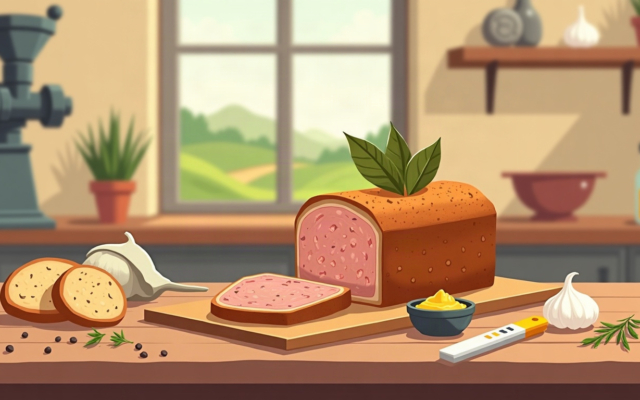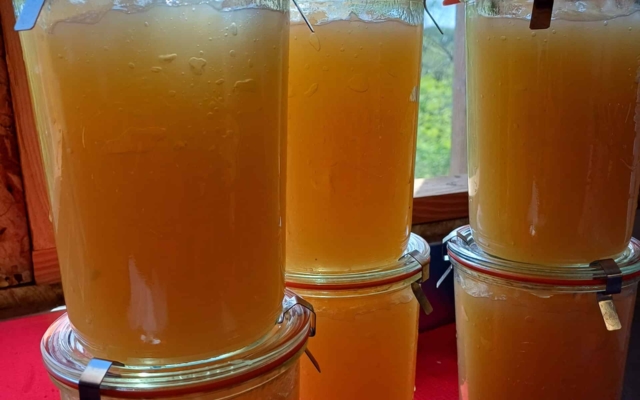

Most rillettes recipes fit into four hours in a covered pot. The charcutiers of Tours, in the Loire Valley, cook theirs uncovered for 5½ to 12 hours, and they have written their rules down in black and white. This guide starts from those rules to give you a homemade pork rillettes recipe that holds up, then tells you honestly how long rillettes keep and why canning them is a problem.
What you’ll learn
- What really sets rillettes apart from pâté, terrine or rillons.
- What the official Rillettes de Tours specification and the French Label Rouge require, with the numbers.
- A step-by-step recipe for 4.4 lb (2 kg) of meat, with the salt measured to the gram.
- How long your rillettes keep, and what you need to know before you put them in jars.
Sommaire
I owe you some honesty before we start: I have never made pork rillettes yet. What I do make is chicken rillettes, with the meat I pick off the carcasses after making my chicken bone broth. I’ll tell you about them further down, because my three attempts taught me something that every pork recipe confirms.
So for the pork, I didn’t want to copy yet another four-hour recipe. I went looking for the documents French professionals actually follow: the official specification of the protected geographical indication “Rillettes de Tours”, published by the French Ministry of Agriculture, and the specification of the Label Rouge “Rillettes pur porc”. They are dry documents, but they spell out everything: the cuts, the salt, the temperature, the time, and even the expected color.
This guide adapts those rules to a home kitchen. When I make my own pork rillettes, I’ll come back and update this article with my numbers.
1. What rillettes really are
1.1 Confit meat, not ground meat
Rillettes are pieces of pork cooked for a very long time in their own fat, until the meat falls apart into fibers. They are then packed into jars with some of that fat, and eaten cold, spread on bread.
What sets them apart from everything else is that the meat is never ground. The Tours specification says so explicitly: the meat is neither ground nor minced, and the pieces separate “through cooking”, without being torn or beaten. It even requires fibers longer than 2 cm (¾ in) in the finished jar.
1.2 Rillettes, pâté, terrine, rillons: what’s the difference?
Pâté starts from ground meat, often bound with eggs or cream, then baked in the oven. It is smooth and you slice it.
A terrine follows the same logic as pâté, with a coarser grind and visible pieces. It bakes in its mold and is sliced too.
Rillons, finally, are the closest cousins of rillettes. They are chunks of pork belly a few centimeters across, browned and confit in fat, but left whole. In the old days, they were cooked in the same pot as the rillettes and lifted out at the end.
1.3 A word from Touraine
The word comes from the Middle French “rille”, which meant a long strip of pork fat. The French dictionary CNRTL records the form “rielle” as early as 1480, and dates the first written use of “rillettes” to 1836, in Balzac. In The Lily of the Valley, he describes “the famous rillettes and rillons of Tours” and “that brown jam” spread on a slice of bread.
Rillettes are often credited to Rabelais. In his Third Book, he does write “I will send you some rillé to your house”, but his editor translates “rillé” as rillons. The word “rillettes” itself does not appear.
1.4 Tours or Le Mans: two schools
There are two great traditions, less than 100 km (60 miles) apart. Rillettes from Tours are cooked uncovered. They are drier and browner, and you can taste the browning. Rillettes from Le Mans are usually cooked covered, steamed in their own juices: their texture is more fibrous, richer and creamier.
Rillettes de Tours have been protected by a European protected geographical indication (PGI) since 2013. That is why their method is the best documented, and it is the one I follow in this guide.
2. What the Tours specification teaches you
2.1 The cuts
The lean meat comes from the collar, the shoulder and the belly. On top of that, the specification requires at least 25% fresh ham or loin in the lean meat. That is what gives the long, beautiful fibers: a ham muscle pulls apart into strands, while the belly melts.
The fat must be a hard fat, like fatback (the fat from the back). Leaf lard, the soft fat around the kidneys, is allowed, but at most 40% of the total fat. The Label Rouge goes the same way and bans soft or oily fats outright.
The cut is coarse: cubes of at least 6 cm (2½ in) for Tours, and at least 4 cm (1½ in) for the Label Rouge.
2.2 Salt, and almost nothing else
The only required ingredient is salt, and plain salt, not curing salt. The specification allows between 5 and 20 g per kilo of meat and fat, that is 0.5 to 2% of the weight. Pepper is optional, up to 2 g per kilo. White wine is allowed up to 15 g per kilo, but only if it is made from Chenin Blanc, the grape of the Touraine wines such as Vouvray.
And that’s it. Water is forbidden. There is no onion, no garlic, no spice blend and no thyme in the text. Nothing stops you from adding them at home, but know that the reference rillettes do without.
2.3 Cooking in three stages
The text breaks the cooking into three stages, all uncovered, in a round pot that is wider than it is deep.
- Browning. The meat is seared at 203 to 239 °F (95 to 115 °C), for 15 minutes to 1 hour, until all the fat has melted. This is what gives the brown color and the roasted taste.
- Slow cooking. The meat confits in its fat at 149 to 203 °F (65 to 95 °C), for 5½ to 12 hours. The text adds that the shorter the cooking, the higher the temperature must be, and the other way around.
- The final blast. The heat goes back up to 203 to 239 °F (95 to 115 °C) for 10 to 20 minutes, to drive off the remaining moisture.
The Label Rouge sets the cooking at 185 °F (85 °C) for more than 8 hours, browning included.
2.4 The expected result
The finished product must be “golden blond to golden brown” in color. It should smell of roast pork and browning. It contains at most 42% fat, and its moisture is capped, which gives it a rather dry, fibrous texture.
One last number says a lot: the yield is below 80%. In other words, so much water evaporates that 2 kg (4.4 lb) of meat and fat give less than 1.6 kg (3.5 lb) of rillettes. That is the price of flavor.
3. The homemade pork rillettes recipe, step by step
3.1 Ingredients for 4.4 lb (2 kg)
This recipe follows the proportions of the Tours specification. For 2 kg (4.4 lb) of meat and fat, you need:
- 400 g (14 oz) of pork collar;
- 400 g (14 oz) of pork shoulder;
- 300 g (10½ oz) of fresh pork belly, skin removed;
- 400 g (14 oz) of fresh ham, in pieces;
- 300 g (10½ oz) of fatback;
- 200 g (7 oz) of leaf lard;
- 30 g (about 1 oz) of fine salt, not curing salt, that is 15 g per kilo or 1.5%;
- 3 g of ground black pepper;
- 30 ml (2 tablespoons) of dry Chenin Blanc, if you have some.
Here the ham makes up 27% of the lean meat, and the leaf lard 40% of the fat. For the salt, I chose 15 g per kilo, right in the middle of the allowed range. Rillettes are eaten cold, and cold mutes salt: below 12 g per kilo, they tend to taste flat.
For equipment, you need a wide, shallow cast-iron pot, a wooden spoon, a kitchen thermometer and very clean glass jars. You don’t need a meat grinder, since the specification forbids grinding the meat in the first place.
3.2 Preparing the meat
Cut the lean meat into large cubes of about 6 cm (2½ in), removing the sinews and gristle. Cut the fatback and the leaf lard into small pieces, so they melt quickly.
Weigh your salt. It is the one step where precision really matters, which is why a scale accurate to the gram beats a spoon.
3.3 Browning
Put the fat in the pot with a thin layer of water or lard, so it doesn’t stick at first. The Label Rouge describes exactly this start. Let it melt over medium heat.
Once the fat has melted, add the meat and stir so every side gets the heat. Let it sear until the pieces are nicely golden. Allow 15 minutes to 1 hour, depending on your stove.
3.4 Slow cooking
Add the salt, the pepper and the wine if you use it, then turn the heat down to the minimum. Don’t cover the pot. The fat should barely shiver: aim for 185 to 194 °F (85 to 90 °C), with your thermometer dipped into the fat.
Stir from time to time so nothing catches on the bottom, but without crushing the pieces. The specification asks you to stir “without tearing the meat apart too much”.
For the time, professionals count 5½ to 12 hours. At home, plan on a whole day. The meat is ready when it falls apart on its own under the spoon.
3.5 Why it takes so long
Meat contains collagen, the tissue that binds the fibers together and makes meat tough. Above 122 to 131 °F (50 to 55 °C), collagen starts turning into gelatin, but slowly. That time is what lets the fibers come apart without any grinding.
Above 140 to 149 °F (60 to 65 °C), the fibers contract and lose their water. In a braise, that is a flaw. Here, it is the point: the water evaporates through the open pot, the meat confits in the fat, and that is what gives the dry, fibrous rillettes of Tours.
3.6 The final blast and adjusting the fat
At the end of cooking, turn the heat up for 10 to 20 minutes while stirring, to drive off the last of the moisture. The pieces should now shred on their own when you work them with the spoon.
Then ladle off the excess fat, until the fibers just break the surface. That is the exact instruction of the specification. Keep this fat: you’ll use it to seal the jars.
3.7 Potting
Fill your jars while everything is hot. The specification requires potting above 149 °F (65 °C). Pack well to push out the air, then cover with a layer of the cooking fat or hot lard.
Let the jars cool, then put them in the fridge as soon as they are lukewarm. Don’t leave them sitting on the counter for hours.
4. What goes wrong, and how to avoid it
4.1 Dry rillettes
This is the mistake I made with my chicken rillettes, and I’ll tell you about it below. The principle is simple: without enough fat, shredded meat stays dry and hard to swallow. If your pork rillettes come out too dry, you can rescue them by mixing in some of the cooking fat you set aside.
4.2 Rillettes that are too salty
The Le Mans rillettes recipe from Le Parfait, the best-known French canning-jar brand, uses 50 g of coarse salt for less than 3 kg of ingredients. Several readers found it too salty and suggest 12 to 15 g per kilo instead. Weigh your salt, and taste cold before adjusting: lukewarm rillettes always seem less salty than they really are.
4.3 Boiled rillettes
If you cover the pot, far less water evaporates and the meat cooks in its own steam instead of confiting. You won’t get the brown color or the roasted taste of Tours rillettes. Covered cooking is the Le Mans way, so it isn’t a mistake, but you then need to watch the moisture at the end and not skip the final blast.
4.4 A bottom that sticks
Such a long cook will always catch on the bottom if you forget to stir. Starting on a thin layer of water or fat, then keeping the heat very low, solves most of the problem.
5. Other meats
5.1 Chicken rillettes: my three attempts
This is the only kind of rillettes I really make. When I make chicken bone broth, a lot of meat stays on the carcasses. I first simmer the carcasses for about 3 hours, take them out, let them cool, then pick them clean by hand. The picked carcasses then go back into the broth for another 5 hours.
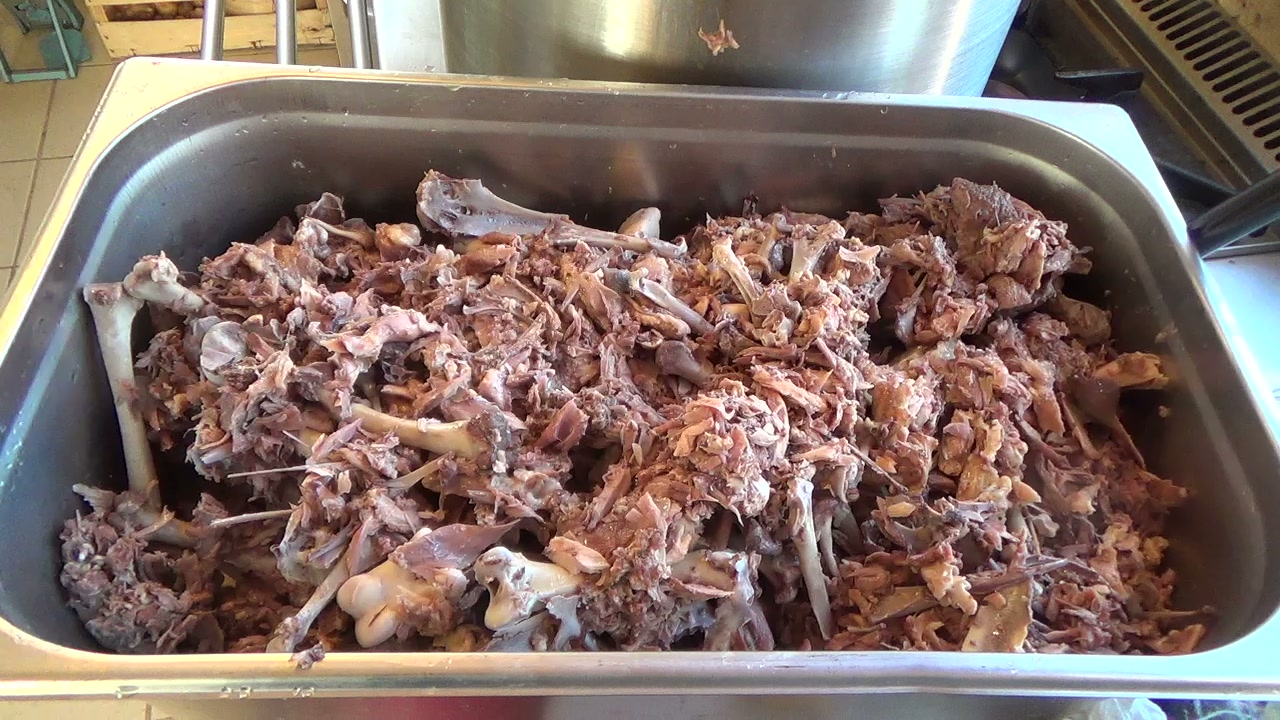
There is more meat left than you’d think. From four carcasses, I got 700 g (1½ lb). In April 2024, I processed 15 kg (33 lb) of chickens bought from my neighbor, who raises them less than a kilometer from my house. The 5 kg (11 lb) of carcasses gave me about 1 kg (2.2 lb) of meat for rillettes, roughly 200 g (7 oz) per carcass. I filmed the whole operation, numbers included, in a video in French: Turning 15 kg of chicken into €280 of terrines.
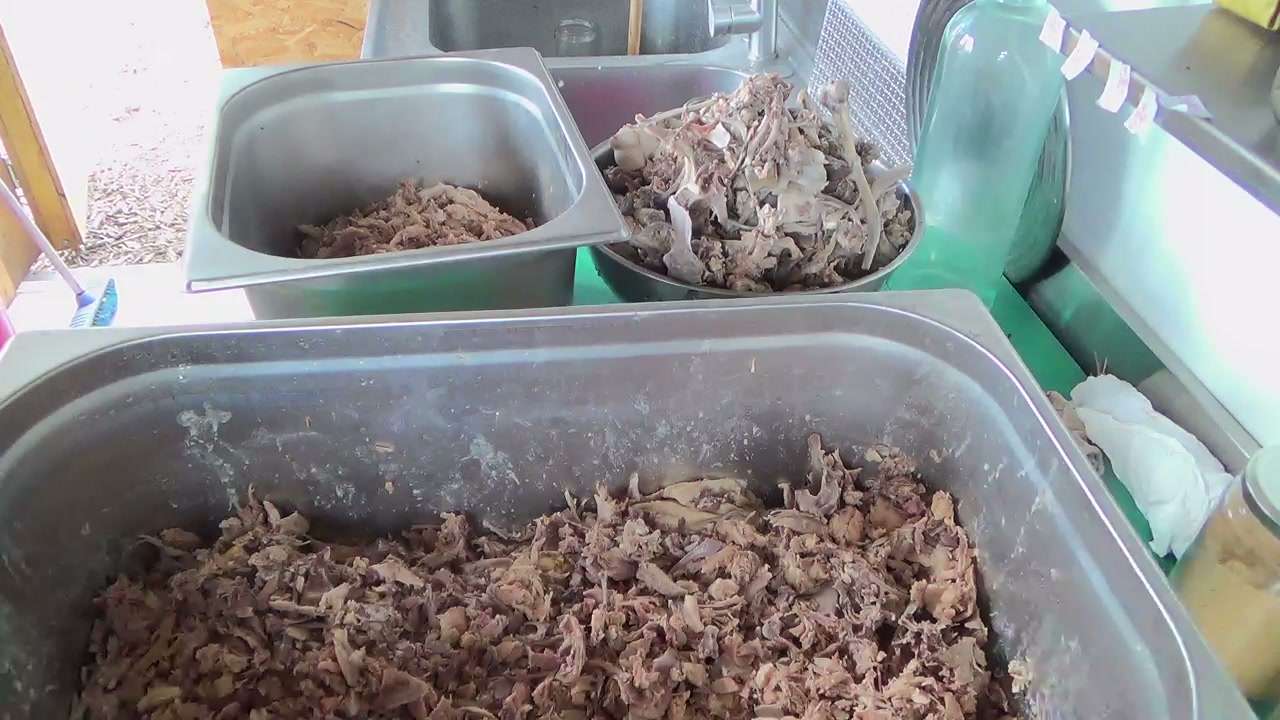
I made three attempts. The first, with no fat at all, was so dry it was hard to eat. The second, with chicken fat, had a taste I found too strong. The third, with pork fat, was by far the most pleasant to eat, and that is the one I kept.
That experience matches what every pork recipe says: rillettes are a matter of fat first. Chicken is a lean meat, and its own fat is very strongly flavored. Pork fat brings the melting texture without covering the taste.
I have to be honest on one point, and I already said it in the video: I’m not sure you can still call them rillettes. Meat from a carcass has cooked for a long time in broth, not in fat. The recipe has lost its original meaning, which was to confit the meat and drive out as much water as possible so it would keep. In my kitchen, it is no longer the fat that preserves them, it is heat treatment in the jar. So it is a very good way to waste nothing from the carcass, but not rillettes in the Tours sense.
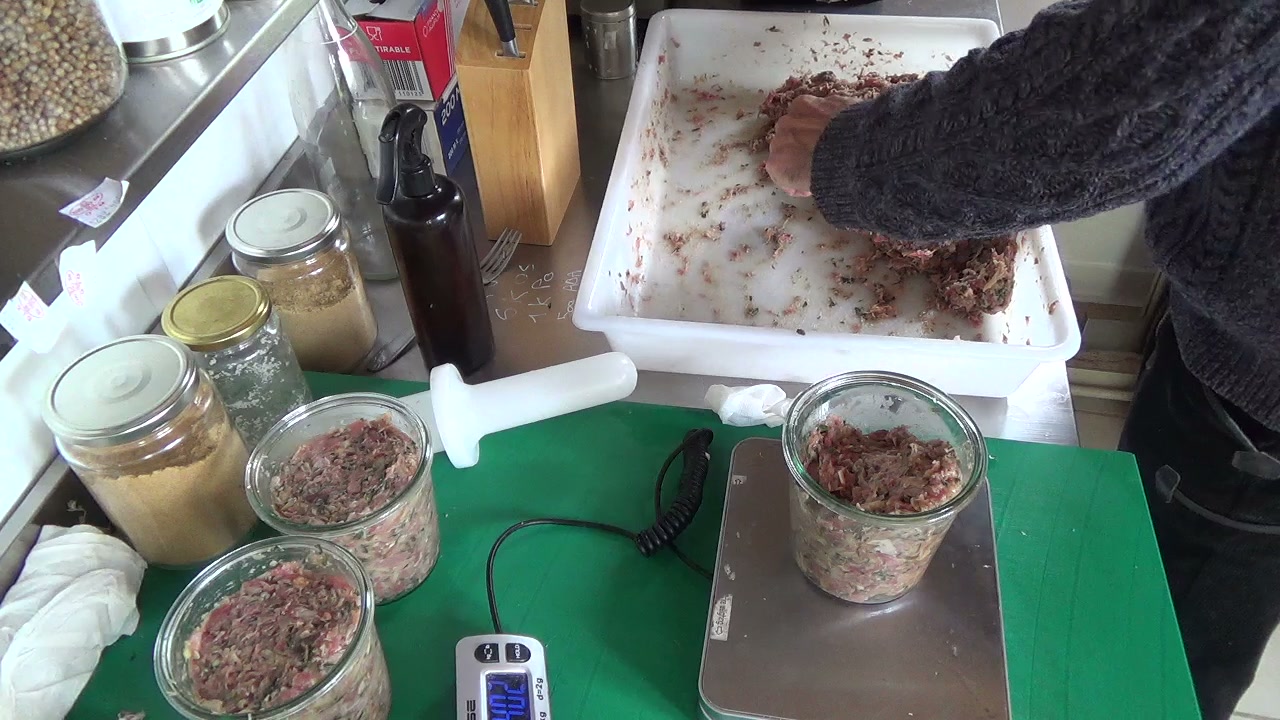
For that heat treatment, I tried two methods on the same recipe. I pasteurized some of the jars at 212 °F (100 °C), and I sterilized the others at 250 °F (121 °C) in a pressure canner. Neither one is based on a tested process for rillettes: that is my own practice, outside any tested process, and I do it knowing the risk. I explain why a little further down, in the part about jars.
I then had friends taste both versions blind, and opinions were split. The sterilized version has a stronger taste, which some of them liked. The pasteurized version is milder, and it is the one I prefer.
5.2 Duck
Duck is fattier than pork, and its fat is excellent. For duck rillettes, you cook raw legs in duck fat, on the same principle as pork. If you start from legs that are already confit, you only need to warm them gently in their fat before shredding them.
5.3 Rabbit and game
Rabbit is lean, like chicken. It needs a good share of pork belly so it doesn’t end up dry. Wild boar and venison have a strong taste, which is often softened with a wine marinade before cooking. They too need the fat of the pig.
5.4 Fish “rillettes”
Tuna, sardine or salmon rillettes are very popular, but they are not rillettes in the strict sense. Cooked fish is mixed with cream cheese or butter, with no long cooking in fat. They keep for much less time: a few days in the fridge.
6. Storage, without kidding yourself
6.1 Rillettes are not shelf-stable
Rillettes in the fridge are not a canned food. They have been cooked but not sterilized, and they only keep thanks to the cold.
Even the professionals of the Tours PGI, with their labs and their controls, allow themselves 29 days at most, at 32 to 39 °F (0 to 4 °C). The specification itself reminds producers that rillettes are bacteriologically sensitive products.
At home, I advise you to stay well below that: 3 weeks at most for a sealed jar, and one week once it is opened. Keep them in the coldest part of the fridge, and always use a clean spoon.
6.2 The fat layer doesn’t do everything
You often read that the layer of fat “protects” rillettes. The Tours specification is more careful: it says it helps “improve preservation”. It limits contact with air, drying out and oxidation, but it replaces neither the cold nor good hygiene.
6.3 The Listeria risk
Rillettes have already been at the center of a listeriosis outbreak in France. Santé publique France, the French public health agency, documented several cases between October and November 1999, linked to commercial rillettes. Listeria has the particularity of growing in the cold, which explains why a product kept in the fridge is not safe from it.
That is also why health authorities advise pregnant women to avoid artisanal charcuterie, rillettes included. In the United States, the CDC likewise advises pregnant women to avoid refrigerated pâtés and meat spreads. If someone in your home is pregnant, elderly or vulnerable, keep your rillettes for later.
6.4 What about canning rillettes?
Many recipes suggest you sterilize rillettes in jars. The Le Parfait recipe, for example, says “2 hours at 212 °F (100 °C)”. You need to know what that number is worth: there is no tested canning process for homemade rillettes, in France or anywhere else.
The National Center for Home Food Preservation (NCHFP), the American reference for home canning, offers no process for rillettes, pâtés or confit. For meat in pieces, all its processes use a pressure canner, never a boiling-water bath at 212 °F (100 °C). It also asks you to remove excess fat, because fat creeps up to the rim of the jar and stops the lid from sealing.
There is something even more troubling. Penn State Extension explains that fat slows the penetration of heat, and that fat molecules surround bacterial spores and protect them from destruction. Rillettes are almost all fat: it is exactly the worst case.
That doesn’t mean nobody cans rillettes. People do it all the time, and have for a long time. But if you do, do it knowing the risk: nothing guarantees safety. If you go ahead anyway, strengthen every safeguard. Your hygiene must be spotless, never shorten the processing time, and throw out any suspicious jar without tasting it. Then add the last safeguard: before eating rillettes from a jar, bring them to a full rolling boil for 10 minutes, plus one minute for every 1,000 ft (300 m) of altitude. Warming them up is not enough, they have to boil. This destroys the botulinum toxin, but not the spores, and it never rescues a doubtful jar: that one goes in the trash.
7. Serving, and what it really saves you
7.1 How to serve them
Take the jar out of the fridge a quarter of an hour before serving. The fat softens, the texture becomes more supple and the flavors come out. Ice-cold rillettes have almost no taste.
Toasted country bread remains the classic pairing. Cornichons and small pickled onions cut through the fat, and a whole-grain mustard works too. To drink, a dry white wine from the Loire is the obvious choice, since that is where rillettes come from. A dry cider works very well too.
7.2 What it really saves you
Making rillettes doesn’t cost much in ingredients, since you mostly use cheap cuts: shoulder, collar, belly and fat. But you have to do the math with the right yield. Because the water evaporates, your 2 kg (4.4 lb) of meat and fat will give less than 1.6 kg (3.5 lb) of rillettes.
To know what you save, add up the price of your cuts at the butcher, divide by the weight of rillettes you get, and compare with the price per pound of artisanal rillettes. You also need to count a full day of cooking, even if you aren’t standing over the pot the whole time.
Conclusion
Rillettes are almost nothing: pork, fat and salt. Everything else is a matter of time and heat. The charcutiers of Tours wrote it into their specification: an open pot, fat that barely shivers, and hours for the meat to fall apart on its own.
If you only remember three things, remember these. The first is to weigh your salt, around 15 g per kilo. The second is not to cover the pot. The third is to eat your rillettes within three weeks.
Rillettes are also one of the best ways to make the most of the cheaper cuts when you buy half a pig. If you’d like another first charcuterie project, my homemade deli ham without nitrites is a good next step. As for me, I fully intend to move from chicken to pork: I’ll come back and complete this guide with my own numbers after my first pot.
Further reading
- The specification of the PGI “Rillettes de Tours”, published in the Official Bulletin of the French Ministry of Agriculture, no. 39-2014.
- Santé publique France, “Outbreak of listeriosis linked to the consumption of rillettes, France, October-December 1999” (2000).
- Penn State Extension, “Caution: Canning with Fats and Oils” (2024).
FAQ
What is the difference between pâté and rillettes?
Pâté is made from ground meat, often bound with eggs, then baked in the oven. Rillettes are made from pieces of meat confit in their fat, which fall apart into fibers without being ground. The Tours specification even forbids grinding the meat at all.
How long do homemade rillettes keep?
I advise 3 weeks at most in the fridge for a sealed jar, and one week once opened. The professionals of the Tours PGI never go beyond 29 days at 32 to 39 °F (0 to 4 °C), with hygiene standards a home kitchen doesn’t have.
Can you can rillettes in jars?
People often do, but there is no tested canning process for homemade rillettes. Fat slows heat penetration and protects bacterial spores. If you do it, do it knowing the risk: spotless hygiene, processing time never shortened, and any suspicious jar thrown out without tasting.
How much salt goes into pork rillettes?
The Tours specification allows 5 to 20 g of salt per kilo of meat and fat, that is 0.5 to 2%. I recommend 15 g per kilo, or 1.5%. Rillettes are eaten cold, and cold mutes salt.
Can pregnant women eat rillettes?
Health authorities advise pregnant women to avoid artisanal charcuterie, rillettes included, because of the listeriosis risk. In the US, the CDC gives the same advice for refrigerated pâtés and meat spreads. Rillettes were behind an outbreak in France in 1999.